
Every small business wants more customers, more enquiries and more sales. But when money is limited, choosing the right marketing channel can be difficult. Should you spend your money on social media marketing or invest in search engine optimization (SEO)?
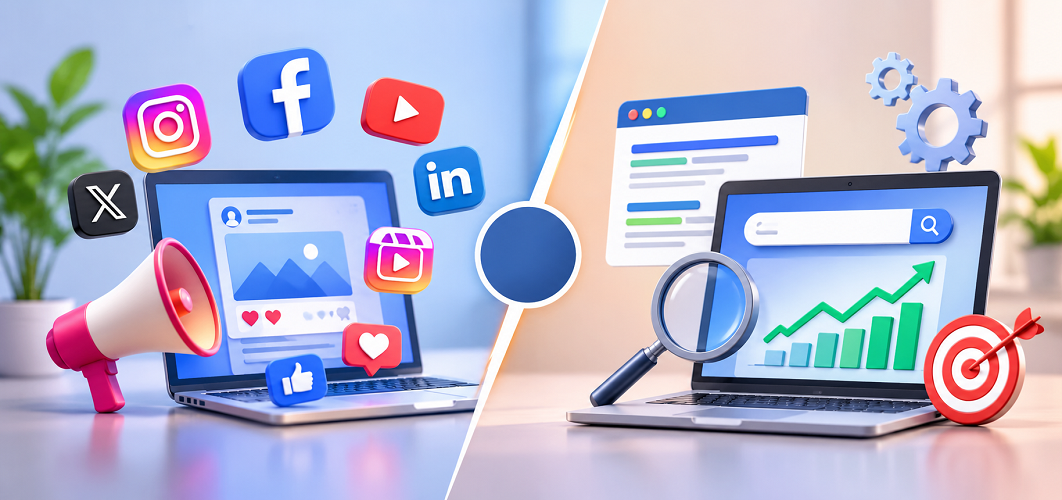
Both can help your business grow, but they work in different ways. Social media helps people discover your brand while scrolling through their favourite platforms. SEO helps people find your business when they search Google for products, services or answers to their problems.
For many small businesses, SEO offers a stronger long-term benefit because it helps attract people who are already looking for what they sell. Social media can still play an important role, especially when a business needs quick attention and customer engagement.
In this blog, we will compare social media marketing vs SEO, explain their costs and benefits and help you understand which option may be the better first investment for your business.
What Is Social Media Marketing?
Social media marketing means using platforms such as Facebook, Instagram, LinkedIn and YouTube to promote a business, connect with customers and increase brand awareness.
For example, a bakery may post pictures of its cakes on Instagram. A clothing shop may share new designs on Facebook. A digital marketing agency may publish useful tips on LinkedIn.
These posts help people learn about the business and may encourage them to visit its website, send a message or make a purchase. Social media marketing is useful because it allows businesses to communicate directly with their audience. However, not every person who sees a post is planning to buy something.
A person may like a picture of a cake without ordering one. Another person may watch a video about a service but never become a customer.
This means social media attention does not always turn into sales.
What Is SEO?
SEO stands for search engine optimization. It is the process of improving a website so that search engines can understand its content and show its pages to people searching for relevant information.
For example, someone searching for “best dentist in Noida” may be looking for a nearby clinic. A person searching for “website design company in Delhi” may be ready to hire a web design agency.
If your website appears for relevant searches, potential customers can discover your business without you having to pay for every click. SEO includes website content, page titles, website speed, useful information, links and other factors that help search engines understand and evaluate a website.
It can also support local businesses that want to attract customers in a particular city or area. Unlike social media posts that may receive attention for a short period, useful website pages can continue attracting visitors for months or even years. Results depend on competition, website quality, search demand and other factors.
Social Media Marketing vs SEO: Key Differences
Although both strategies support business growth, they attract customers in different ways.
| Factor | Social Media Marketing | SEO |
| Main purpose | Build awareness and engagement | Attract relevant search traffic |
| Audience | People browsing social platforms | People searching for information or services |
| Customer intent | May be interested but not ready to buy | May already need a product or service |
| Results | Posts can gain attention quickly | Usually takes time to build results |
| Long-term value | Often depends on continued activity | Strong pages can bring traffic over time |
| Website traffic | Can send visitors through posts and profiles | Can attract visitors directly from search results |
| Trust | Builds familiarity through regular interaction | Useful content and search visibility can build trust |
| Cost | Organic posting costs time; ads require a budget | SEO requires time, skills, tools or professional services |
| Control | Depends on platform rules and reach | Depends on search engine rules and competition |
| Best suited for | Awareness, community and engagement | Search visibility, relevant traffic and long-term growth |
The right choice depends on your business goals. However, when a small business wants steady website traffic and customers who are actively searching for its services, SEO often has an advantage.
7 Reasons SEO Can Be a Better Investment Than Social Media Marketing
-
SEO Reaches People Who Are Already Looking for Your Services
One of the biggest advantages of SEO is customer intent. Imagine that you own a plumbing business in Delhi.
A person watching a funny video on Instagram may notice your plumbing advertisement, but they may not need a plumber at that moment.
Now imagine another person searching Google for “emergency plumber near me.” This person has a clear problem and may need help immediately.
If your website appears in relevant search results, you have a chance to connect with someone who already needs your service. This is why SEO can attract highly relevant visitors. Instead of depending only on people noticing your business, you can reach people actively looking for a solution.
-
SEO Can Deliver Long-Term Results
Social media posts often receive most of their attention shortly after publication. Some posts become popular later, but many quickly disappear from people’s feeds. SEO works differently.
A useful page explaining your services can continue appearing in search results long after it is published. If the page answers customer questions and remains relevant, it may attract new visitors over a long period.
For example, a website design company may have a page targeting “website design services for small businesses.” If that page ranks well and attracts relevant searches, it may continue generating enquiries without needing a new social media post every day. SEO is not permanent or guaranteed. Search rankings can change and websites need maintenance. However, strong organic visibility can become a valuable business asset.
-
SEO Can Reduce Dependence on Paid Advertising
Many social media platforms offer paid advertising to reach more people. Paid campaigns can be useful, but the traffic they generate generally depends on continued spending.
When the advertising budget stops, the additional reach from those campaigns usually stops too. SEO offers another source of website visitors through unpaid search results.
For example, a small furniture business may spend money every month promoting its products on social media. It could also attract visitors through useful product pages that appear when people search for specific furniture items.
SEO still has costs. Businesses may need to pay for content, website improvements, expert support and tools. Results also take time. The difference is that SEO can build visibility that continues to provide value after the initial work, rather than relying entirely on ongoing advertising payments.
-
SEO Can Bring More Relevant Website Traffic
Getting thousands of website visitors is not useful if none of them needs your product or service. The quality of visitors matters more than the total number.
SEO helps businesses connect their website pages with relevant searches. For example, a company selling office chairs may attract more useful visitors through a page targeting “ergonomic office chairs for small offices” than through a general social media post seen by a broad audience.
Visitors arriving through relevant searches may be more interested in learning about prices, features, delivery or purchasing options. This can improve the chances of turning website traffic into enquiries and sales, although actual results depend on the offer, pricing, website experience and competition.
-
SEO Builds Trust and Credibility
People often compare several businesses before making a decision. They may look for service details, customer reviews, pricing information, answers to common questions and examples of previous work. A website that provides clear and helpful information gives potential customers more reasons to trust a business.
Strong search visibility can also help people discover a brand they have not heard of before. However, appearing in search results does not automatically make a business trustworthy. Honest information, real experience, good service and positive customer experiences remain important.
-
SEO Can Support Customers at Different Stages of Buying
Not every customer is ready to buy immediately. Some people are learning about a problem. Others are comparing options. Some are ready to contact a provider.
SEO can help businesses reach people at each stage. For example, a person searching for “what is website maintenance” may be learning about the topic. Someone searching for “website maintenance services for small businesses” may be comparing providers.
A person searching for a specific service in their city may be closer to making a purchase. By attracting relevant searches, SEO can help a business connect with potential customers before they are ready to buy and remain visible when they begin comparing services.
-
SEO Can Help Small Businesses Compete With Bigger Brands
Small businesses often have smaller marketing budgets than large companies. Competing for attention on social media can be difficult when bigger brands have professional creative teams and large advertising budgets.
SEO creates another opportunity. A smaller business may be able to attract relevant visitors by serving a specific location, customer group or service need better than broader competitors.
For example, a local accounting firm may not need to rank for every accounting-related search across India. It may benefit more from being visible to people looking for accounting services in its own city.
SEO does not guarantee that a small business will outrank a large company. Competition still matters. But focused search visibility can create valuable opportunities without requiring the biggest advertising budget.
What Are the Limitations of Social Media Marketing?
Social media marketing company in Noida has several benefits, but business owners should understand its limitations.
- Reach can change: A platform may change its rules or algorithm, affecting how many people see your posts.
- Attention can be short-lived: A post may receive likes and comments but stop attracting attention after a few days.
- Engagement does not always mean sales: People may watch videos, share posts or follow a page without becoming customers.
- Consistent activity takes time: Businesses often need to keep publishing useful content to maintain visibility and audience interest.
- Paid reach can increase costs: Reaching a larger or more specific audience may require advertising expenditure.
These limitations do not mean social media is a poor investment. It can be especially valuable for businesses that depend on visual products, community engagement, personal connections or repeat customer relationships. The important point is that social media attention and business growth are not always the same thing.
Is SEO More Affordable Than Social Media Marketing?
There is no fixed answer because both channels offer different budget options. Social media can bring quick attention, but regular content and paid ads may require ongoing spending. SEO may need more initial investment in website improvements, content and technical work, but successful pages can attract visitors for a long time.
Both channels have different benefits and results are not guaranteed. For small businesses, the best choice is the one that generates more valuable leads and sales within their budget.

Should Small Businesses Invest in SEO or Social Media First?
For many small businesses, SEO is the better first investment when the main goal is to attract people who are actively searching for their products or services. However, the best starting point depends on the business model.
Choose SEO First If:
- Your customers search Google before contacting a business.
- You provide services such as plumbing, legal advice, accounting, web design or digital marketing.
- You want to attract enquiries through your website.
- You serve customers in specific cities or locations.
- You want to build a long-term source of organic traffic.
- Your business can wait for results to develop over time.
For example, a local dentist may benefit from appearing when nearby patients search for dental treatments. A digital marketing agency may attract enquiries from companies searching for SEO services. In these cases, SEO can connect the business with people who already have a clear need.
Choose Social Media First If:
- Your product depends heavily on pictures, videos or demonstrations.
- You need to introduce a new brand to people who do not know it exists.
- Your customers spend a lot of time on social media.
- You sell products that benefit from trends, creators or community recommendations.
- You need to build an active community around your brand.
For example, a fashion brand selling a new clothing collection may gain attention through Instagram videos and creator partnerships. A restaurant may use social media to show new dishes and attract local interest.
Social media can help create demand for products that people may not have been searching for in the first place.
When Should You Use Both?
Many businesses benefit from using SEO and social media together. For example, an interior design company can use SEO to reach people searching for local designers and social media to share project photos, videos and customer stories.
SEO helps people find the business, while social media builds trust and interest. Together, they can generate more enquiries and customers.
Common Mistakes Small Businesses Should Avoid
Whether you choose SEO, social media or both, avoid these common mistakes.
Expecting instant results from SEO: SEO usually takes time. Competitive industries may need sustained work before meaningful results appear.
Measuring success through likes alone: Likes and followers do not always translate into paying customers. Enquiries, qualified leads, sales and customer acquisition costs matter more.
Ignoring website quality: Even if your website attracts visitors, confusing service information, slow pages or difficult contact options can prevent enquiries.
Choosing a channel without understanding customer behaviour: The best platform is the one that helps you reach your actual customers, not simply the one that is popular.
Expecting guaranteed rankings: No ethical SEO professional can guarantee a specific Google ranking. Results depend on many factors outside a business’s control.
Stopping SEO too early: Giving up after a short period may prevent a business from seeing the long-term value of its investment.
Ignoring the value of trust: Marketing can attract potential customers, but good service, honest communication and customer satisfaction help turn them into loyal buyers.
Frequently Asked Questions (FAQs)
- Is SEO better than social media marketing for small businesses?
SEO is often better for businesses that want long-term website traffic and enquiries from people actively searching for their services. Social media may be more useful for brand awareness, visual promotion and customer engagement. The best choice depends on your business goals and audience.
- How long does SEO take to show results?
SEO results vary by website, competition, industry and the quality of the work. Some improvements may become visible within a few months, while competitive keywords may take considerably longer. SEO should be viewed as a long-term investment rather than a quick fix.
- Is social media marketing cheaper than SEO?
Not always. Organic social media posting can be inexpensive, but creating content and running advertisements require time and money. SEO also involves costs, but successful organic rankings may continue attracting visitors over time. Compare both channels by the customers and sales they generate.
- Can SEO generate leads without paid advertising?
Yes. SEO can attract visitors through unpaid search results. If your website answers customer questions and explains your services clearly, some visitors may contact your business or make a purchase. Results depend on search demand, competition and website quality.
- Do small businesses need both SEO and social media marketing?
Not always at the beginning, but using both can be valuable. SEO can attract people searching for specific products or services, while social media can build awareness and customer relationships. Businesses with limited budgets can prioritise one channel before expanding into the other.
Conclusion: Invest in the Channel That Brings the Right Customers
When comparing social media marketing v/s SEO agency in Noida, remember that both can help your business grow, but they serve different purposes. Social media is useful for building awareness, showing products, connecting with customers and creating interest. SEO is especially valuable for attracting people who are already searching for your products or services, building long-term website visibility and generating relevant organic traffic.
For small businesses that want more website enquiries and steady customer growth, SEO is often the stronger first investment, particularly when customers actively search for the services they need.
However, businesses that rely on visual discovery, trends or community engagement may benefit from starting with social media. The smartest choice is not necessarily the channel that gets the most attention. It is the one that helps your business reach the right people, earn their trust and turn interest into paying customers.
Start by understanding how your customers find businesses like yours, then invest in the marketing channel that best matches their needs and your long-term goals.